New Mexico Early Childhood Education and Care Department
July 2026 - October 2026
Why This Matters For Families
In 2025, New Mexico became the first state in the nation to offer all families no-cost universal child care. The program aims to expand families’ access to affordable, high-quality child care and increase the number of child care providers. Participating families are expected to save an average of $12,000 per child annually. New Mexico’s approach may offer valuable lessons for other states as they consider how to expand child care options for families while launching a universal child care program.
Implementation Challenge
There is not enough child care capacity to achieve universal coverage in New Mexico; an estimated 12,000 new child care spaces are needed to achieve a fully universal system. New Mexico is counting on growth in the number of registered home child care providers as a primary pathway to increasing the capacity of the child care system, especially in rural areas.
As an initial goal, New Mexico aims to add 1,000 registered home child care providers with the capacity to serve 4,000 children. The current home child care provider registration process includes burdensome aspects that make it challenging to become a registered home child care provider.
To address these challenges and help support the universal child care expansion, the New Practice Lab (NPL) worked with the New Mexico Early Childhood Education and Care Department (ECECD) to research and map the experience of would-be providers as they start and run a license-exempt, home-based child care business — identifying the barriers they face and which are most important to address first to increase provider supply.
Our Approach
Over an eight-week sprint, the New Practice Lab interviewed 12 registered home child care providers (six English-speaking, six Spanish-speaking) and consulted stakeholders across the ECECD leadership and staff, local early childhood coalitions, and community-based organizations (CBOs) to understand specific barriers to provider registration. The team reviewed relevant regulations, standard operating procedures, process documentation, existing research on provider experiences in New Mexico, and ECECD and CBO materials to support registration. NPL further surveyed providers who recently left the field or abandoned the application process, asking why they left and what might have changed their decision.
Based on this research, the team produced journey maps of the provider registration experience, identified opportunities for improvement, and recommended potential solutions to increase provider supply.
What We Learned
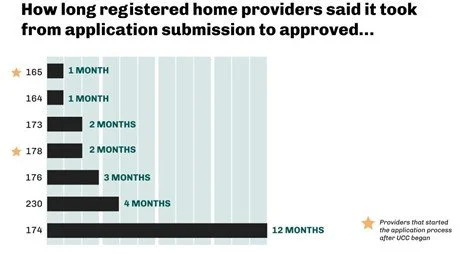
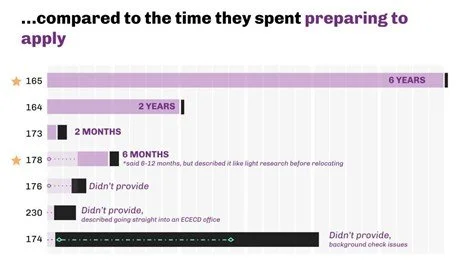
One recurring theme we’ve heard from our interviews with registered home providers: once they submit an application, ECECD approval usually comes fairly quickly, typically within one to four months. The longer part of the journey often happens before they ever apply. Some providers told us they spent months, and in a few cases years, getting ready.
What takes so long? Providers described:
Background check issues that had to be resolved before submitting the complete application
Preparing their home to meet county and state requirements
Nervousness about starting a business, doing everything "correctly," and the background check itself
Waiting on ECECD for responses and guidance on next steps
Unclear information about the process, especially for providers who navigated it on their own
These graphics show how the time from submission to approval compares with the time providers spent preparing to apply.
Next Steps
After wrapping up the provider-focused discovery work, the New Practice Lab is conducting a second phase of journey mapping focused on the family experience of finding and accessing child care in New Mexico’s universal program.
Together, these two projects will surface opportunities for ECECD to design and implement features of the universal program grounded in the realities of family and provider experiences, and help to determine where to make technology investments in the next three years. Further, lessons in New Mexico can inform efforts in other states as they seek to increase the supply of affordable, high-quality child care.