Streamlining early intervention services in Illinois
Illinois Department of Early Childhood
August 2025- November 2025
Why This Matters For Families
Early intervention (EI) services under IDEA Part C is a federally mandated, state-run program that has supported the healthy development of infants and toddlers from birth to three since 1986. These services are designed to provide a variety of supports to infants and toddlers diagnosed with or at-risk of developmental delay or disability, as well as for their families, with the goal of enhancing their early development and long-term success.
The experience of families who access (or don’t access) developmental support for their infants and toddlers is — or should be — of great interest to policymakers. As our team has covered in an earlier effort this year, early intervention helps infants and toddlers eat, sleep, move, speak, and play better. Early intervention uses a family-centered approach that takes into consideration a family’s environment, routines, and preferences, and integrates the family into services for children. When families can access the program, the impacts can be profound: Early intervention helps strengthen cognitive, motor, and language skills, reduces the likelihood of childhood maltreatment, and can lower education costs through reduced need for special education.
Identifying a child’s need for EI services is challenging and marks just the beginning of an often complex journey of learning about, applying for, and navigating these services. Just 53 percent of the 560,211 children across the US referred for early intervention services are ultimately enrolled. That leaves nearly half of referred children unserved, to say nothing of the thousands more children who are likely eligible but never referred to begin with.
Implementation Challenge
Unlike means-tested programs, any child with a developmental delay or disability is entitled to early intervention, but first they must be identified, referred, evaluated, and enrolled, before ultimately receiving services. Unfortunately, there are policy and implementation challenges at every step in the process that can hinder access to care.
The Illinois Department of Early Childhood (IDEC) is a newly consolidated state early childhood agency that will formally launch on July 1, 2026. For IDEC to take over administering early intervention from the Illinois Department of Human Services, it needs to understand how EI is currently run. As the new team begins to stand up their office, build out their strategy, identify budget and staffing needs, and formulate their priority list, the New Practice Lab began mapping current processes across the service experience.
IDEC was eager to learn more about implementation issues that might arise in the Lab’s process mapping efforts, especially as they may intersect with current system challenges. Currently, 40,000 infants and toddlers access EI in Illinois each year, but a combination of increasing caseloads and provider shortages is straining the system’s resources. This presented an opportunity not only to understand processes but also to highlight implementation and efficiency concerns for IDEC to consider as they decide where and how to allocate existing resources and plan for future innovations and state investments.
Ultimately, this sprint engagement may lay the groundwork for Illinois to act as a model for other states; Illinois will be the largest state to have consolidated child care and early intervention services under one early childhood agency, potentially simplifying and unifying care for families with young children.
Our Approach
Through a mix of desk and field research (more on methods in the table below), the New Practice Lab defined and mapped existing processes for three IDEC priority areas:
Family eligibility: The process by which an infant or toddler is deemed eligible to receive services (e.g., referral, intake, assessment) and then receives services and support (including Individualized Family Service Plans or IFSPs, identification of therapists, and receipt of therapies), ongoing communication, and transition to Early Childhood Special Education if applicable
Provider eligibility: The process by which an EI service provider becomes eligible and maintains eligibility to serve EI families, receives clients, and gets compensated for their time
Payments: Process for billing, fees, and reimbursement, including how EI providers bill the state, how the state bills Medicaid and receives reimbursement, how the state and EI service providers bill private insurers, and how the state assesses and collects family fees
When our work surfaced findings related to other areas of concern, the Lab captured and communicated them with IDEC partners.
OBJECTIVE
Contextualize our team’s work within the landscape of previous research and understand state dynamics
WHAT WE DID
Reviewed earlier IDHS and other EI stakeholder reports on system performance to understand what’s already been proposed and contextualize our findings in the Illinois EI ecosystem
WHAT WE DELIVERED
A catalog of key recommendations from earlier stakeholder reports on the Illinois EI landscape
OBJECTIVE
Work in the open and in partnership with other stakeholders
WHAT WE DID
Met regularly with other EI research teams, led knowledge sharing sessions, briefed the state’s Interagency Council on Early Intervention in a regular IICEI meeting, and government stakeholders in a preliminary shareout onsite in Chicago
WHAT WE DELIVERED
Slide decks, early service maps, and, when feasible, folders of shared resources in the state’s internal collaboration space
OBJECTIVE
Map the current workflows and end-to-end processes within the Illinois EI system
WHAT WE DID
Reviewed existing internal documentation of process flows, and materials (including forms, informational websites) available to families and providers
Interviewed program staff (including case workers, billing and finance, payment processors, adjudicators, program leaders), providers (PT/OT/DT), independent and providers affiliated with service organizations)
Connected with the IDEC vendor conducting first-person research efforts with EI-served families to gather family experience insights
Catalogued existing program and service performance measures (particularly useful for later as opportunities are identified for improvement)
WHAT WE DELIVERED
Created service maps detailing the payment processes and the end-to-end program journey. The visual artifacts include details about required notifications, decisions and consents; handoffs between agencies; the process of approvals, denials, and exits; required Information formats, technical requirements, and more.
Service Blueprint: Visual reflection of the real-world current state of the end-to-end journey of various users and stakeholders within the early intervention ecosystem
Payments Flow Process Map: Diagrams the insurance, billing and payment processes throughout the EI system
Synthesized learnings into a comprehensive report documenting phases and steps of each process and accompanying process maps (visual artifacts) for specific phases like referral and payment processing
OBJECTIVE
Understand and communicate the flexibilities that exist within the current legal and regulatory landscape
WHAT WE DID
Compiled, reviewed, and mapped existing Illinois regulations to federal requirements and built a tool to help understand the difference between what the state has to do and what the state can do
WHAT WE DELIVERED
A State-to-Federal policy crosswalk illustrating the relationship between Illinois regulations and statutes and the actual federal requirements, and areas of opportunity.
OBJECTIVE
Identify a range of cataloged opportunities (e.g., near-term, longer term, high return on investment, feasibility) for service delivery improvement
WHAT WE DID
Drawing from our team’s multidisciplinary strengths, we synthesized what we learned about EI operations, provider, service coordinator, and family experiences, and policy opportunities to form concrete suggestions for service improvement, seeking validation and feedback from stakeholders where possible, and noting alignment with prior research where known.
WHAT WE DELIVERED
A comprehensive set of recommendations along three primary areas: actions to unify EI strategy across the services delivered by the new department, increase data access and use, and reduce burden and complexity.
““We had, unfortunately, a service coordinator [whose] caseload was way too heavy. Her caseload was over 100 kids—Oh my gosh, it was really hard to get a hold of her and I understand why! It was frustrating as a parent when I’m trying to contact our service coordinator and I might not hear back for two weeks.””
““It usually takes me like an hour to process everything and pull from everywhere and put everything together. Because you have to go into Cornerstone and you have to plug in a bunch of stuff from the provider reports. But Cornerstone doesn’t let you copy and paste from the provider reports…This is actually crazy to say out loud. So you can log in through like the Citrix, which is where you log in through Cornerstone to Microsoft Edge and you can log into your Gmail account, pull up the provider reports in your email and you can copy and paste only if you’re logged in through Microsoft Edge. This doesn’t even make sense when I say it out loud.””
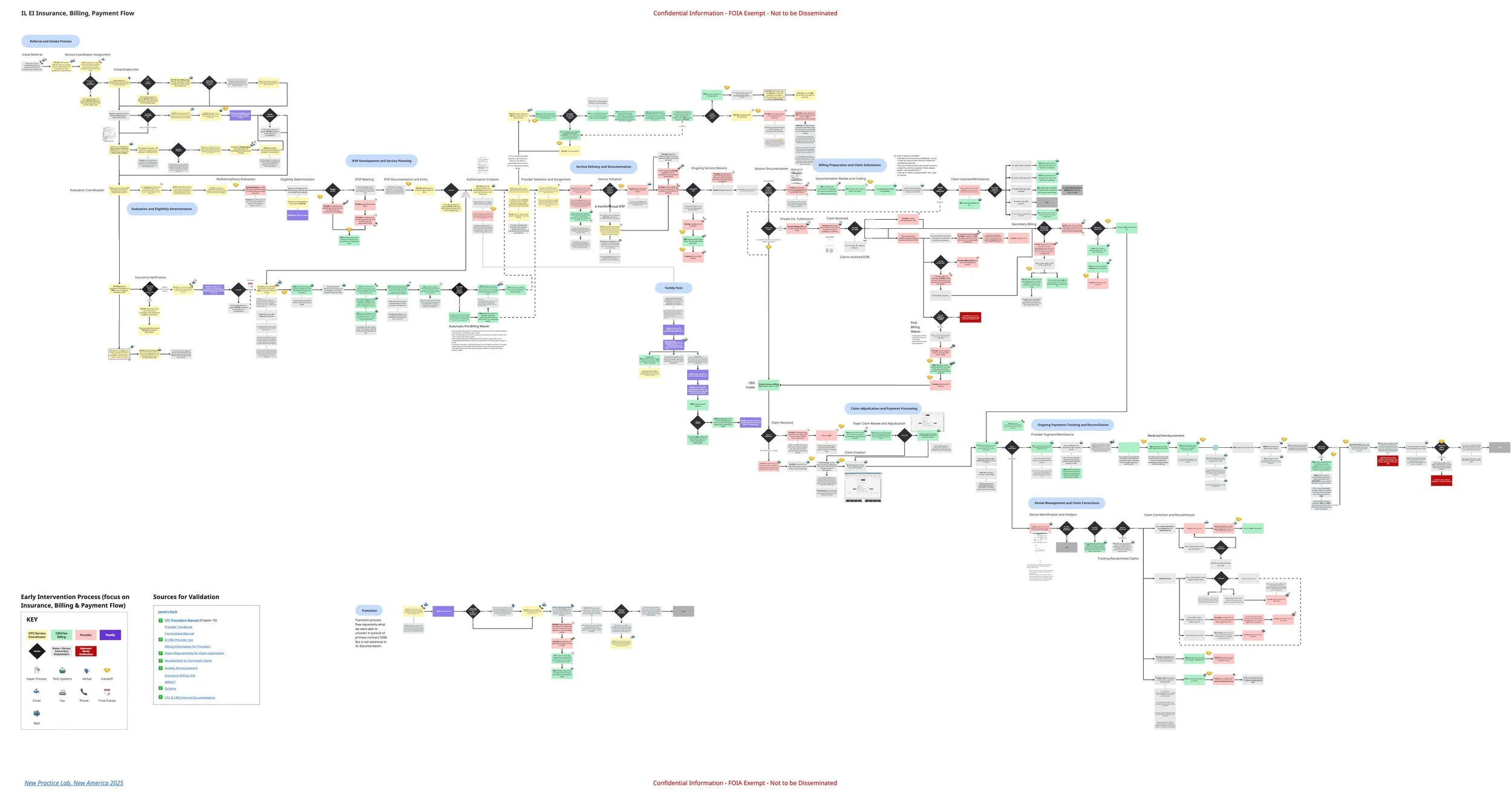
A diagram of the payment flow process
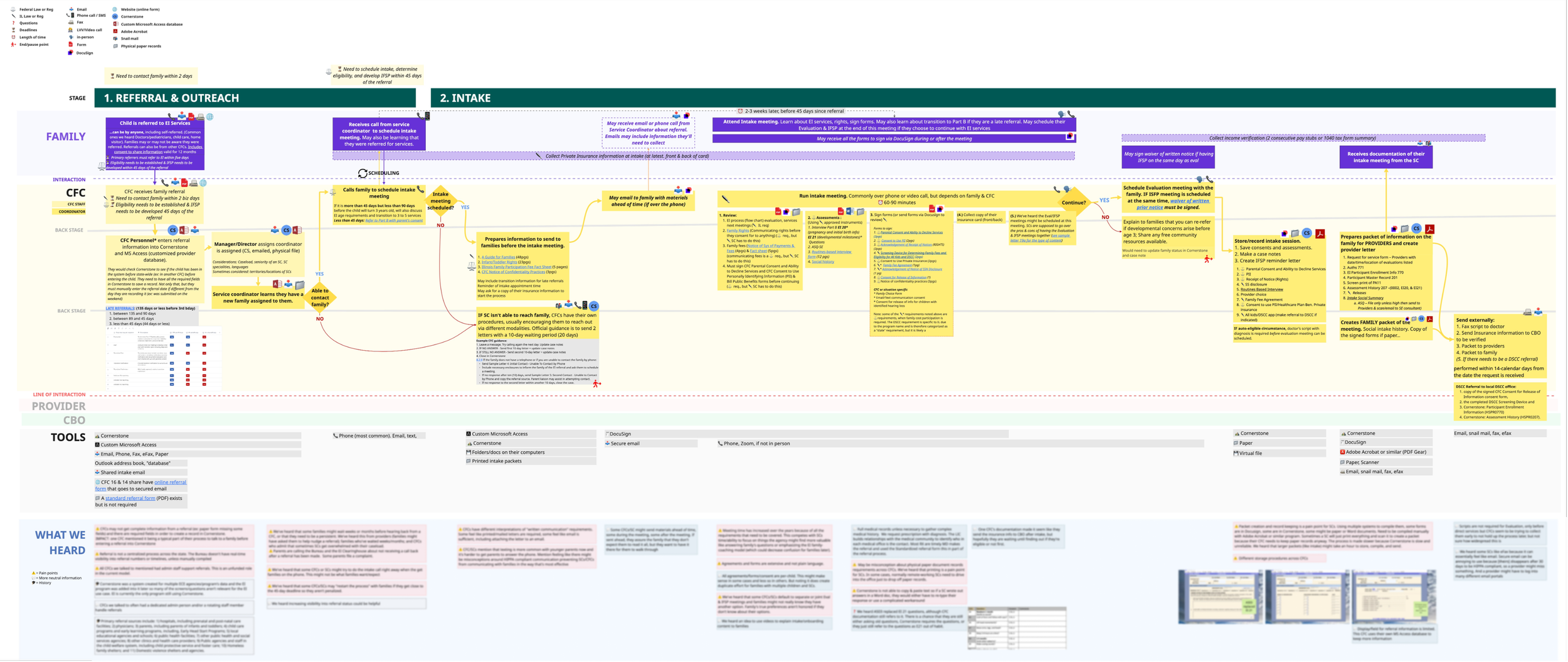
What We Learned
An intensive discovery sprint in which critical services are mapped start to finish, from a variety of perspectives, can be incredibly useful to a team, particularly one that is standing up a new unit.
In doing this work, our team was able to identify a number of improvement opportunities that IDEC is currently discussing internally, but at a high level:
The EI system in IL extends across departmental and agency entities, even with the new centralized IDEC umbrella. Like many places, each of these individual entities works in a task-based silo. With the formation of IDEC, there’s an opportunity to integrate across organizational boundaries more efficiently, oriented around the service interaction experienced by the customer (like a family or provider) rather than separate tasks owned by different government entities. The process maps we developed identified several areas where handoffs could be made more seamless.
The process and technological tools used to guide families through the enrollment process are complex, decentralized, and outdated. As a result, there is limited access to system data about providers, payments, and cases, hindering the state’s capacity to make data-informed decisions about the efficiency and equity of their early intervention work.
Next Steps
After completing this initial engagement to support IDEC in gaining a deep understanding of the current state of EI implementation in the state, the New Practice Lab is eager to continue working with IDEC to act on some of the recommendations and further develop the necessary structures and processes for the new agency. In early 2026, we will design the next implementation sprint with IDEC to pressure-test ideas and interventions, collaborating with other Illinois stakeholders as needed.