Learning about peer networks as a trusted messenger to encourage credit uptake in New York City
The City of New York Innovation Team
September 2025 - November 2025
Why This Matters For Families
Across the country, millions of families are living paycheck to paycheck, struggling to afford their basics on low to moderate incomes. To support these families, 31 states and the federal government have instituted the Earned Income Tax Credit (EITC), which can provide families with thousands of dollars after filing their federal and state taxes. Tax credits have become a critical anti-poverty program in the United States, providing an essential source of cash for many American workers and families.
The 2021 expansion of the Child Tax Credit (CTC) in the American Rescue Plan reduced child poverty in the United States by 40% that year. However, accessing credits like the CTC is notoriously difficult as they are claimed during annual tax filing. The bipartisan, highly successful EITC reaches only 80% of eligible households nationwide, with lower-income, less-educated households being most likely to leave money on the table compared to other populations. The IRS estimates that roughly 20% of EITC-eligible and CTC-eligible individuals do not receive the credit payments they are owed — the federal EITC alone averaged $2,500 per return in 2022.
In New York state, almost half a million children live in poverty. In Richmond County, New York, a family with two adults and two children needs about $13,000 a month to live.
Implementation Challenge
In 2025, New York expanded the state’s child tax credit, increasing tax credit access to 2.75 million children statewide. This was the largest expansion of the child tax credit in the state's history, and could help families defray the rising cost of living. New York City’s Innovation Team coordinated efforts across multiple city agencies to conduct outreach to public housing residents about tax credits in Spring 2025 ahead of the April 15th tax filing deadline.
Seeking to ensure the expanded CTC is utilized in 2026, the Innovation Team sought to continue outreach efforts to raise awareness among parents in low-income communities, piloting a few efforts to inform a larger push in the first quarter of 2026.
The New Practice Lab partnered with the Innovation Team to better answer three questions:
Is a new approach to outreach — personalized peer-to-peer network outreach — effective?
Does a nudge to make an appointment with a nearby free tax help site helpful to include in outreach materials?
Does a nudge to file by Nov 15 ( the late filing deadline for those who aren't required to file but can benefit from credit) help increase tax filing?
Our Approach
OBJECTIVE
Better understand people’s perspective on personalized peer-to-peer network outreach and messages that would raise awareness and encourage filing and credit claiming
WHAT WE DID
Usability tested draft outreach text messages with 6 NYC residents, iterated on language with participants to settle on final recommended language that seemed to resonate with a large audience
Further developed text messages that parents could send to their network that directed people to nearby free tax prep site
ORIGINAL OBJECTIVE
Understand language and messaging that spurs action (like making an appointment at nearby help site and ultimately file)
WHAT WE DID
While we had hoped that this sprint with New York City would allow us to test these messages and peer-to-peer approach, we were unfortunately unable to fully implement the pilot given logistical limitations within the tight timeframe.
We did, however, partnered with a local IRS-certified VITA site to list their information in flyers placed in a school in Staten Island, a YMCA, and a public housing building.
The YMCA distributed flyers to 200 families and sent a text blast to 100 families. Ultimately, only 10 people used the short URL or scanned the QR code on these flyers, which were up for around 3 weeks.
What We Learned
Through our user research, we gathered valuable input to the design of messages, language, and how to set up potential relational outreach efforts.
The six participants offered feedback, which included things like:
Preferring the message starts with a question
Not over-promising how much money you might get back
Emphasizing the need to use casual language and avoiding “spammy” sounding language
Participants were intrigued by the peer-to-peer and would have been interested if it was available for their neighborhood
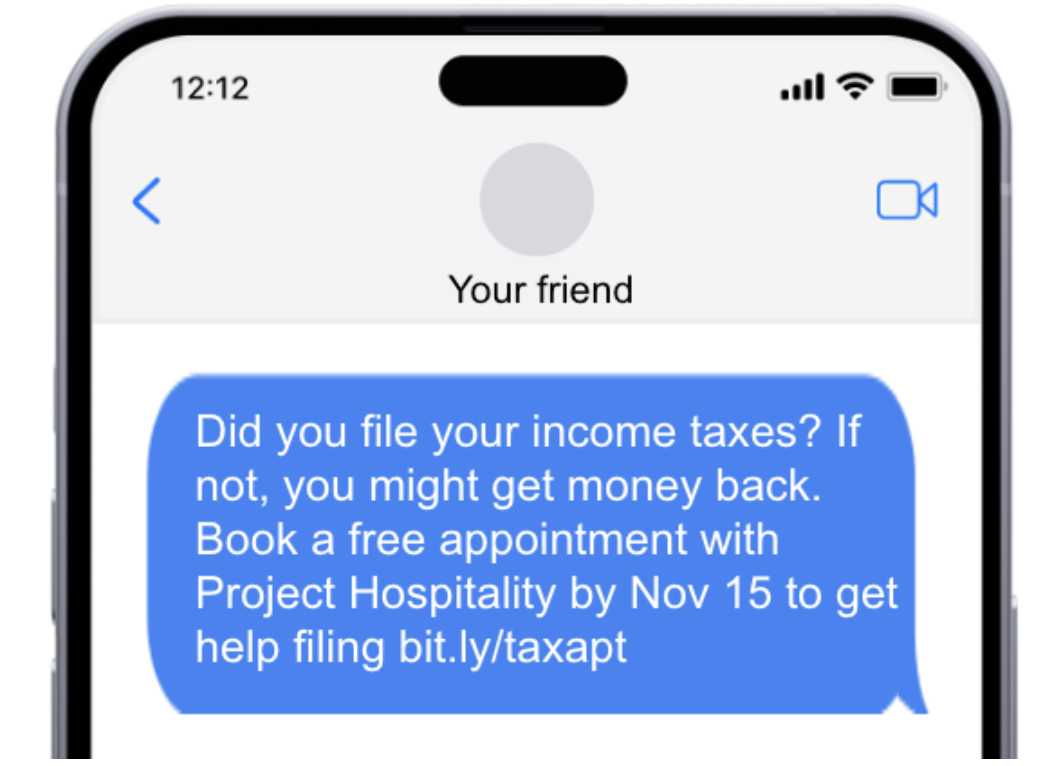
Final text we recommended for a future peer-to-peer messaging experiment
While this timeframe did not align to active partnerships with school professionals to pilot these specific outreach messages, through interviews, we learned about the potential for schools as a meaningful messenger for future efforts:
New York City schools are well versed in helping families, particularly in low-income areas, connect with support services and benefits. Schools have effective, trusted communication channels they can use to connect with parents. Other initiatives like the “Caring for Our Caregivers”, which was started as part of this outreach effort, is anotherexample of outreach connects families to college readiness, adult education, wellness resources and free tax consultations.
Parent coordinators are eager to connect families with services, but understandably need a longer lead time to include tax credit access awareness in their workload.
Next Steps
Through this and other tax efforts, the New Practice Lab tax team is developing a suite of resources including user-tested messages and outreach approaches that can be replicated in locations across the country. We continue to discuss opportunities to implement a true field pilot of a peer-to-peer outreach intervention with the New York City Innovation Team and members of our Tax Implementation Working Group.