Envisioning the future for Illinois’s Early Intervention Program
Illinois Department of Early Childhood
January 2026 - April 2026
Why This Matters For Families
The experience of families who access (or don’t access) developmental support for their infants and toddlers is — or should be — of great interest to policymakers. Early intervention helps infants and toddlers eat, sleep, move, speak, and play better. Early intervention uses a family-centered approach that considers a family’s environment, routines, and preferences and integrates the family into services for children. When families can access the program, the impacts can be profound: early intervention strengthens cognitive, motor, and language skills, reduces the likelihood of childhood maltreatment, and lowers educational costs by reducing the need for special education.
Identifying a child’s need for EI services is challenging and marks just the beginning of an often complex journey of learning about, applying for, and navigating these services. Unlike means-tested programs, any child with a developmental delay or disability is entitled to early intervention, but first they must be identified, referred, evaluated, and enrolled before ultimately receiving services. Unfortunately, policy and implementation challenges at every step of the process can hinder access to care. Just 53 percent of the 560,211 children across the US referred for early intervention services are ultimately enrolled. That leaves nearly half of referred children unserved, to say nothing of the thousands more children who are likely eligible but never referred to begin with.
Implementation Challenge
The Illinois Department of Early Childhood (IDEC) is a newly consolidated state early childhood agency that formally launched on July 1, 2026. As a new department, they are trying to both make improvements urgently needed across programs now in their purview while maintaining progress towards a strategic, longer-term vision for how they deliver on their mission for young children in Illinois.
In our first sprint with IDEC in 2025, the New Practice Lab mapped current EI processes across the service experience, identified pain points, and provided recommendations to address them, which supported the new team’s efforts to stand up their office, build out their strategy, identify budget and staffing needs, and formulate their priority list.
In this next phase, the New Practice Lab shifted the focus toward the future vision for early intervention in Illinois. We built on findings and deliverables from the first sprint to translate select findings into concrete improvements and drive toward a cohesive, desired future state for Illinois’ Early Intervention program that is not rooted in current limitations.
Our Approach
The New Practice Lab developed a vision for Illinois’ EI program in five years, based on IDEC’s goals and desired impacts, with a priority on a streamlined family experience. This vision builds on recommendations from the New Practice Lab’s 2025 engagement, aligns with federal and state requirements, and aims to improve collaboration among relevant state agencies.
A static roadmap would be too rigid for a five-year time horizon because IDEC needs to adapt to new information, evolving priorities, and emerging real-world barriers. From our first engagement, we learned there was real value in creating a shared story among stakeholders due to uneven knowledge across the parts of the EI program. To that end, we developed storyboards illustrating what Illinois’ EI system could look like if the 2025 recommendations were acted upon — a conversation piece leadership could easily follow and staff could use to advocate for the work needed to get there.
We designed a series of three storyboards; two focused on different kinds of families and how they could experience EI, and one focused on the service coordinator, who acts as the hub of EI. These are intended to help IDEC imagine what an excellent customer experience could look like for families and children.
Family Storyboards: The family storyboards demonstrate that excellent systems must support the most difficult use cases, not just the “happy paths.” The families in the storyboards included those who move from an urban to a rural setting and still need equitable care; have medically-complex children who require a larger support team; don’t speak English as a first language; and have varying levels of confidence with technology. In each family storyboard, the EI system adapts to the family’s needs and provides a seamless experience that “just works.”
Service Coordinator Storyboard: The service coordinator storyboard shows how the system illustrated in the family storyboards is supported. The crux of the service coordinator’s story is that they have sufficient technical support; service coordinators can manage their caseloads and provide tailored support to families because they no longer need to spend the majority of their day on time-consuming administrative tasks. Recognizing that technology alone cannot transform a program, the storyboards also reference critical policy changes that improve provider supply and reduce burden across the system, focusing on tailored care for families.
We paired the storyboards with supplemental materials that detail different policy, process, and technological ideas to realize them, and discussion prompts. Together, these artifacts are designed to enable IDEC leadership and stakeholders engage with a concrete representation of the vision, drive alignment, and adapt the vision as the landscape evolves.
Storyboard Example
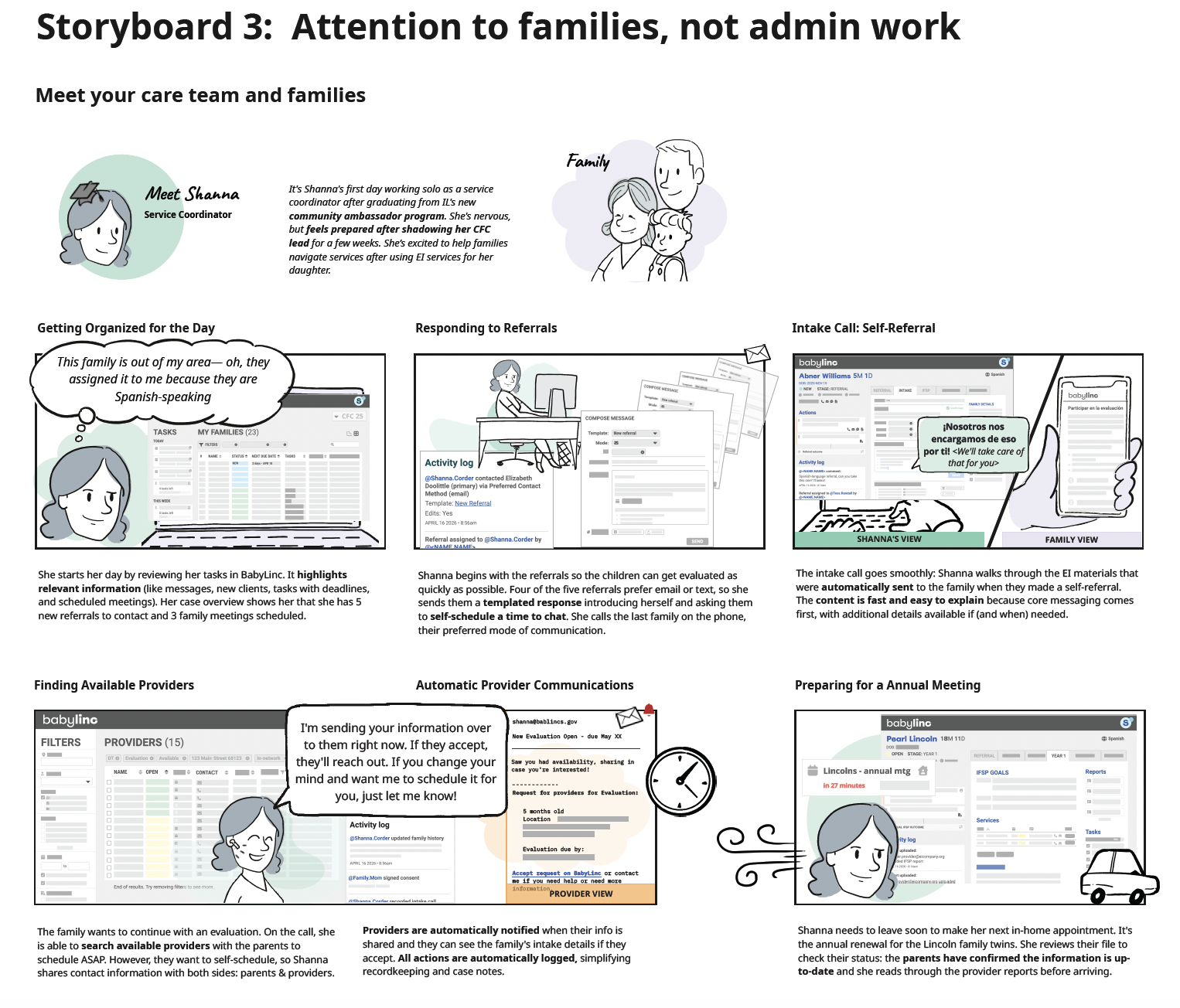
Partial screenshot of one of the three storyboards we developed for IDEC. This one describes how service coordinators could provide more tailored support to families if they were better supported by policy, processes, and technology improvements.
Documentation Examples
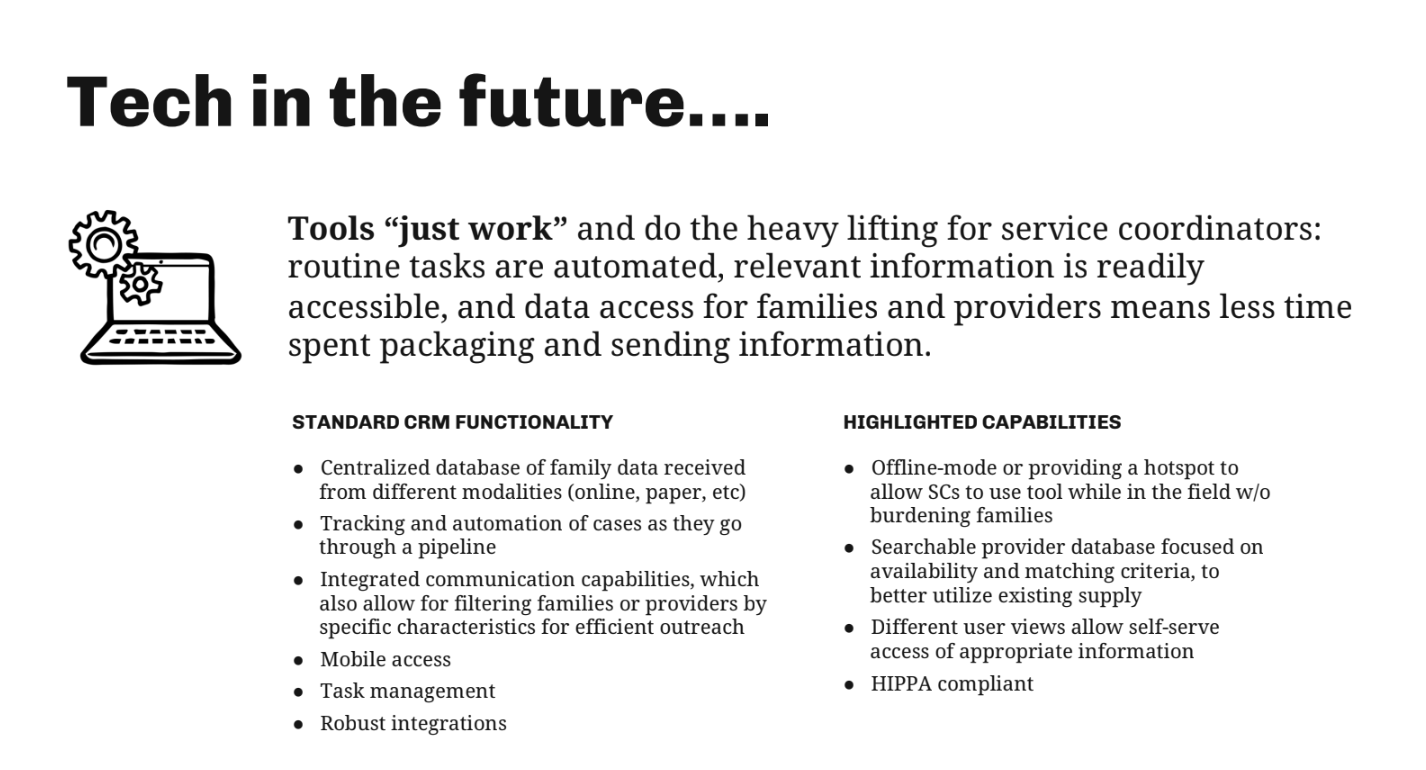
Screenshot of supporting documentation describing the technical changes we imagine underlying the new storyboard.
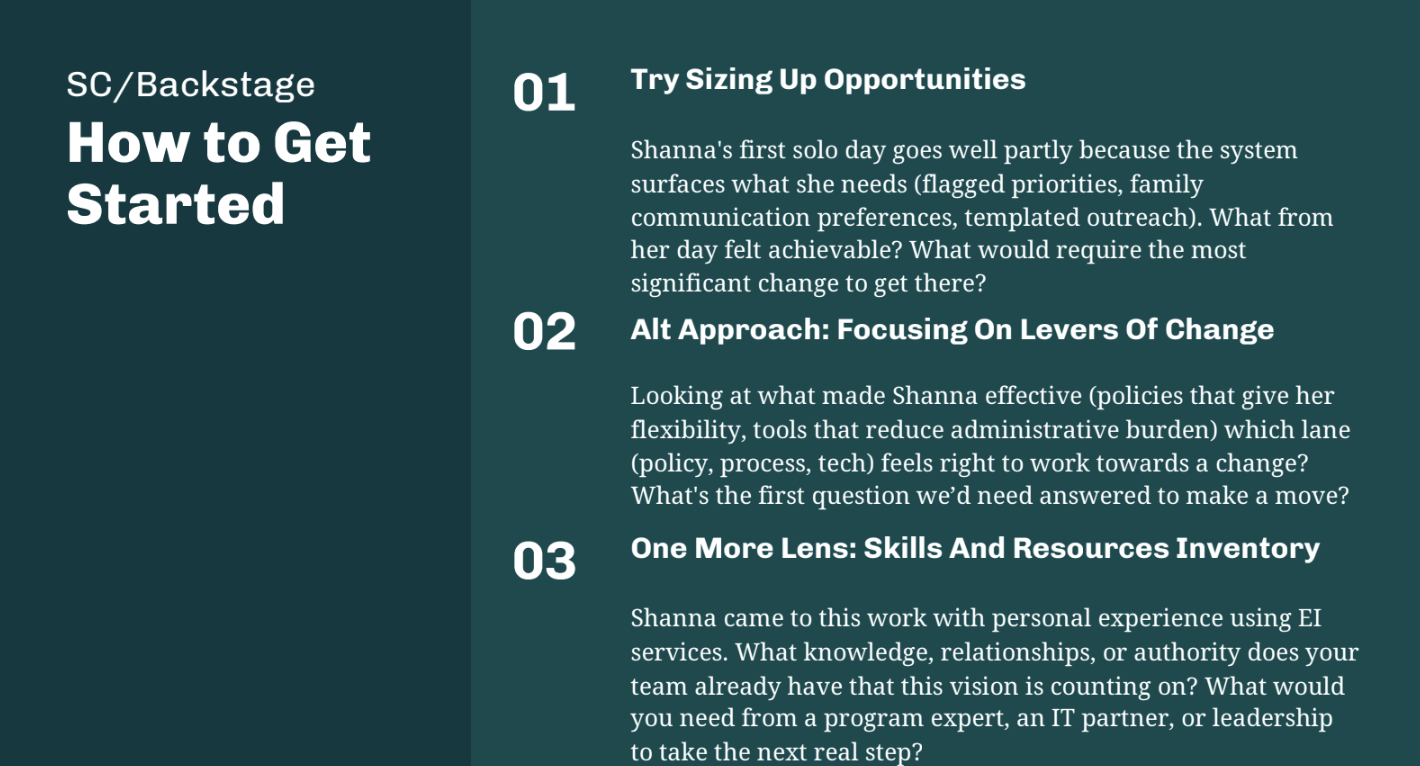
Discussion prompts were included to help the storyboards spark discussion and action.
What We Learned
Designing what excellent customer service could look like surfaced a number of policy ideas for Illinois’ consideration, including:
Improving provider supply by offering higher pay, travel reimbursements, and missed appointment reimbursements to providers who extend their service area
Streamlining service authorizations, which are a key piece of IL’s EI infrastructure linking cases, provider credentials, and payment compliance , without delaying service delivery..
Incentivizing cross-provider collaboration and joint goal-setting to support family-centered care and a more streamlined experience for families.
Next Steps
Across both engagements, NPL identified similarities in the provider supply dynamics between EI and early education and care (ECE). We plan to build on these learnings during the upcoming work to increase provider supply in future engagements.