Technical Input to Virginia’s Paid Family and Medical Leave Law
Virginia
2026
Why This Matters for Families
Virginia’s SB2 and HB1207, passed by the state legislature and approved by Governor Abigail Spanberger on April 22, 2026, establishes a new statewide paid family and medical leave program. Virginia is the 14th state, plus the District of Columbia, to create a new statewide paid family and medical leave program.
Once the program is fully launched in December 2028, millions of workers in Virginia will be eligible to receive up to 12 weeks of paid leave to bond with a new child, recover from their own serious health condition, care for a sick family member, or respond to domestic violence, sexual assault, or stalking. Paid leave is associated with higher labor force participation rates, higher earnings over time, better health, worker retention and productivity, and economic growth. This program will provide critical economic support and job-protected time to care for Virginia’s workers and their families.
Implementation Challenge
Beginning in 2016 and growing in earnest in the years following, state advocates and national paid leave experts have built an engaged coalition in the Commonwealth and have worked closely with the Virginia legislative bill sponsors to revise and reintroduce the state bill establishing a paid family and medical leave program within the Virginia Employment Commission. An important consideration for revising the Virginia bill has been learning from other existing state paid leave programs.
Getting public programs approved and funded takes enormous effort, but it's only half the battle. After the bill is signed and the money is appropriated, another challenge awaits: delivering a new service to people that is on time, on budget, and working as expected. Despite the importance of implementation, few mechanisms exist to help legislators and public servants stand up new and innovative programs.
In the last six years, eight states have launched new paid family and medical leave programs and started providing paid leave to eligible workers in their states - and the New Practice Lab has partnered with several of these programs (including Maryland, Minnesota, and New Jersey) to help improve their implementation. Many of the existing state programs were patterned to some extent on the legacy of older state programs, where pre-existing temporary disability insurance provided a backbone for the addition of paid family and medical leave. In the newer states, however, programs needed to be built from scratch, and this has offered both challenges and new opportunities for innovation in implementation.
We have learned valuable lessons about claims processing, medical certification, and navigator outreach and application support, among other components of paid leave administration. We have written about these lessons From Law To Launch and we collaborate and share best practices with a cohort of paid leave administrators and data leads. All of our work involves listening to the front line program administrators and families we serve to improve the effectiveness of reaching as many people as possible. These lessons have demonstrated it’s possible, through well designed policy higher upstream, to improve workers’ uptake, employers’ interfaces, and to ease administration of the program.
Our Approach
In collaboration with Vicki Shabo and other paid leave experts and advocates, the New Practice Lab provided implementation-focused feedback to drafters as part of their preparations to reintroduce the bill in the 2026 state legislative session. Drawing on our team’s expertise in implementation, our practices of listening to families on what they need from policy, and consistent with our overall strategy, we created a feedback loop between implementation lessons and policy development.
NPL Strategy
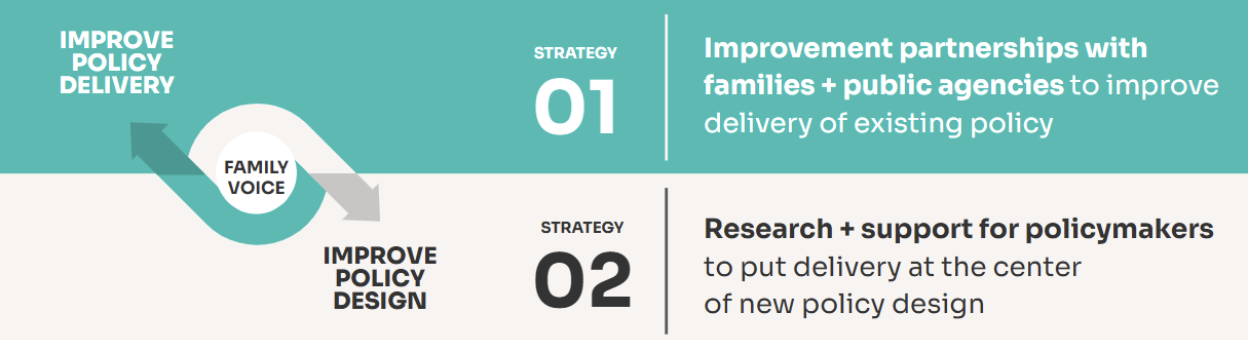
It is important not only that we provide more families with access to paid family and medical leave but that with each new program we improve the experience and reduce friction in delivering this policy. While not advocating for specific language, the New Practice Lab shared insights from other states about feasible implementation timelines for program start-up, and — once benefits are available — payment timelines, the mechanics of medical certifications, data sharing needs for smoother processing, and the role of technologists and human-centered design in state agencies responsible for program implementation.
When bill sponsors State Senator Jennifer Boysko and State Delegate Briana Sewell drafted final language, lessons learned from other states’ implementation experience were reflected in bill language introduced in the General Assembly in 2026, and are present in the final version of the bill that was signed into law.
Additionally, during consideration of the Virginia paid family and medical leave bill in early 2026, NPL provided requested advice to departmental staff that will be responsible for paid leave program implementation in Virginia on considerations for the implementation of a new program. We provided technical assistance and resources to their team on the following operational topics:
Start-up costs of administering a paid family and medical leave program.
Technology and software that they will need to procure or custom build, how to do agile and quick procurement, and which vendors and contractors work in the paid leave ecosystem.
The number of staff and skills of staff that they will need to hire, and how to hire the best people quickly.
Lessons learned from other state paid leave programs related to costs and worker protection enforcement.
How to stand up fraud prevention and detection systems.