
Thriving Families at the New Practice Lab
Why This Work Matters For Families
While the past decade has brought important policy gains for families, the truth remains that raising children in the United States is often way too hard. Household expenses typically rise with the birth of a child—just as family income often falls. The financial strain and emotional stress many families face stem from a complex mix of factors, not least of all are the difficult choices some families are forced to make between working and caring for their child during those early months. And economically precarious families raising young children have fewer resources and greater barriers to address those challenges. All families deserve to thrive, and to have access to opportunities and support to achieve their dreams.
Our institutions need both new ideas and better ways of working to help families have agency and access what they need to thrive. Too often, policy is designed for families, not with them. Families are experts on their lives, and know what they need. We must build more pathways to strengthen family voices in how we design and deliver policies.
The New Practice Lab is part of a growing movement of leaders and organizations committed to designing and improving policies and programs in close partnership with the families they are meant to serve. This moment in time calls for fresh thinking and deep curiosity about what the experiences and dreams of American families are, as the foundation to build new solutions that enable those families to thrive.
Our Approach
In the New Practice Lab’s initial series of sprints (2020-2022), low income families with young children emerged as an acutely underserved population that interacts with a multitude of government supports. The Lab identified a need to more holistically understand these families’ perspectives, beyond the scope of a single form or program, where much “civic tech” service design and human-centered design research activities occurred to date. Inspired, in part, by the new Customer Experience Executive Order in 2021 that focused on a “life experience” approach to service design, the Lab’s new human-centered research effort sought to better understand families’ evolving challenges more broadly. This could enable family voices to inform social policy design and delivery, and the effort sought to co-design a blueprint of how we can more comprehensively support healthy, happy, thriving families.
The methods and research plan designed by a mixture of design and policy experts at the Lab were influenced by Lab Fellow Hilary Cottam’s work. Hilary came to the US to run a series of workshops called “imaginations” to design and imagine supports for an ideal working life.
In 2023, the team began spinning up cohorts of families across the country—varied in their backgrounds and makeup—that experience financial insecurity and have at least one child under six years old. A cohort kicks off with an in-person, 3-hour co-design workshop, in English or Spanish, co-hosted with a community partner that helps to identify participants. The Lab seeks to make these workshops as accessible as possible, providing a meal, free childcare, scheduling during evening or weekend hours, and compensating participants for their time and sharing of their expertise.
For the 18 months following the workshop, the families engage with the Lab through a remote digital diary study, offering insights into the joys and challenges of raising young children. Questions cover a variety of topics:
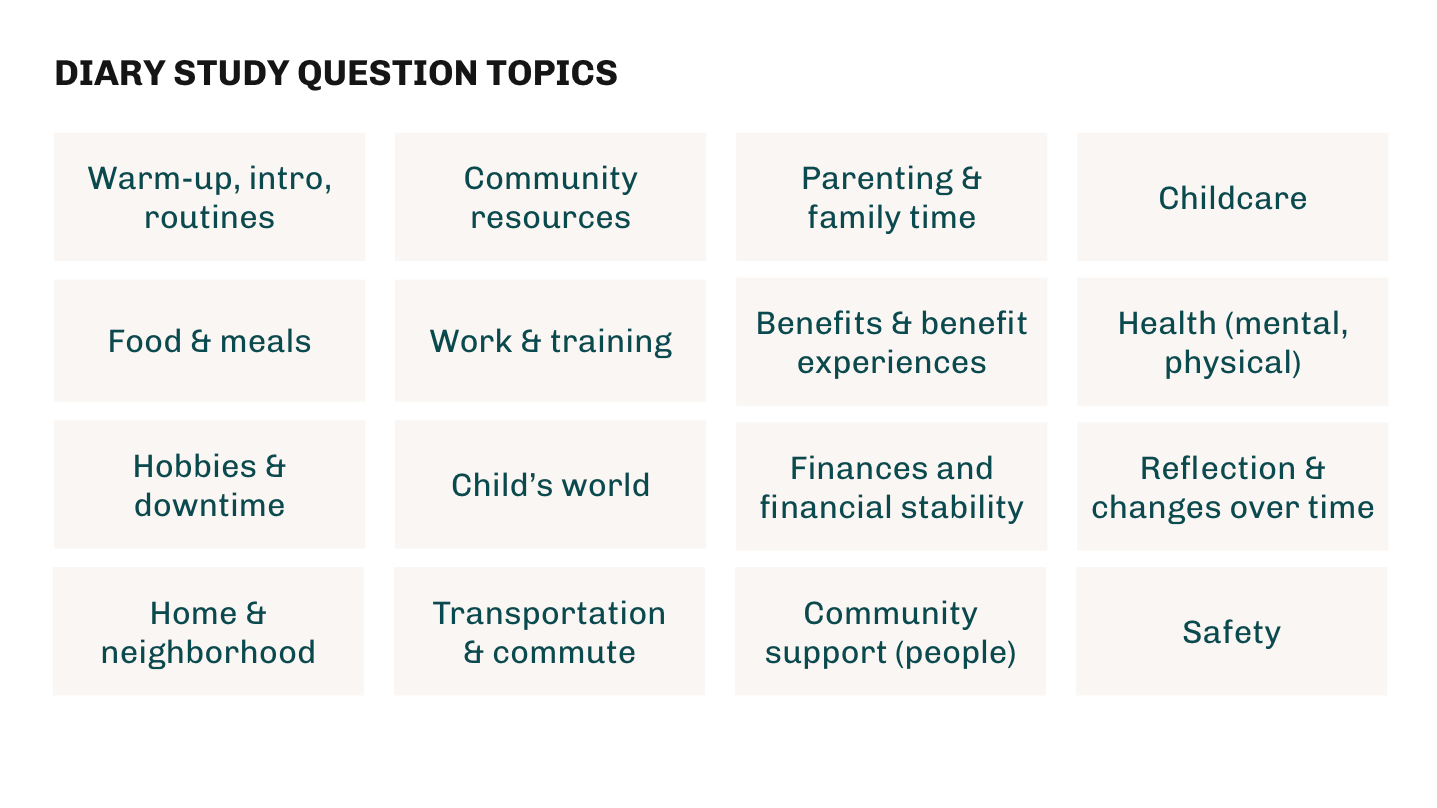
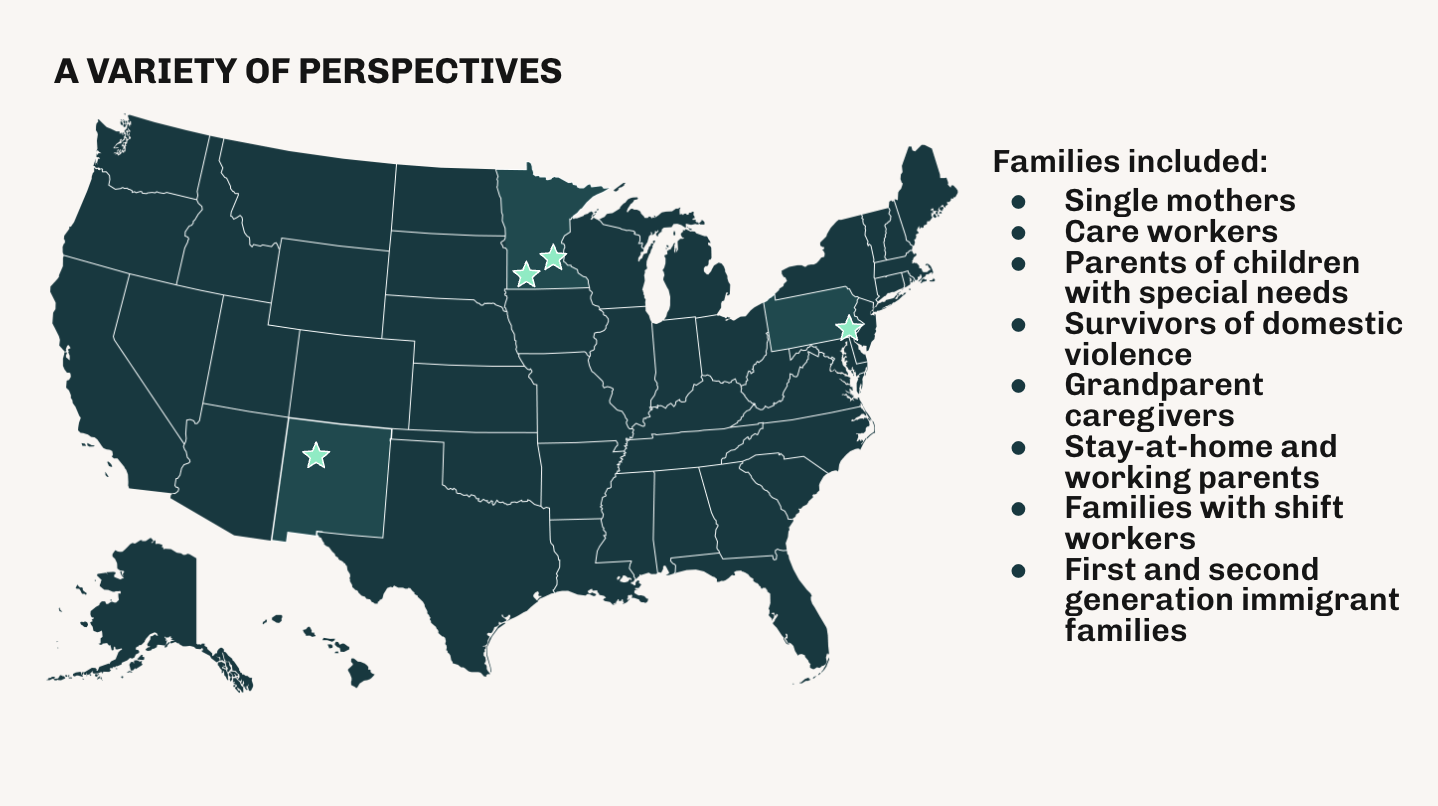
To date, the team has analyzed nearly 2,000 submissions from families. Participants represent a broad range of perspectives, and geographies.
What We’ve Learned
Across the cohorts we’ve worked with in three states and five areas, a number of themes have emerged. The data they’ve shared with us is incredibly rich, and we were continually reminded that families are diverse! They have different approaches, preferences, and experiences. But, throughout their many comments, one thing was clear and consistent with others’ research: they deeply value and believe in their family.
Initially, we set out to learn across four areas of inquiry. These are our findings at the highest possible level. Linked throughout at the bottom of this page are additional publications that dive more deeply into specific topics, and we will continue to share more as we pull together issue-specific briefs. We shared our findings back with families in the Pennsylvania and Minnesota cohorts to validate that our findings were consistent with what they intended to share. This is a critical step in inclusive research.
AREA OF INQUIRY: UNDERSTANDING FAMILY CONTEXT AND CHARACTERISTICS
What are shared and distinct experiences, resources, or routines?
LEARNING: MAKEUP AND SITUATIONS CAN CHANGE OVER TIME, SOMETIMES BY SURPRISE.
The families in our study were diverse, and their situation and context often changed over the course of the 18-month study. We had families who moved, whose household makeups changed, whose caregiving responsibilities changed. We had families where partners split up, where an incarcerated parent was released from prison, where adult children moved home, where there were tight and large age gaps between children, where grandparents provided day-to-day care to multiple of their children’s children. We had not one but two families give birth to their second set of twins! Serving families means understanding that needs are not static.
““A time I felt not supported at all was when I found out I was pregnant with my daughter. I was living in Florida and I only had her dad to turn to. Once I left my daughter’s dad and was homeless… I moved back to Minnesota to be back with family. It was hard at first, but I found programs and food shelf to help”
“I’m grateful for what you see around me. A place to live. And car to get me where I’m going. I’ve worked hard for it and I’m proud of myself.”
“When I graduated, I was 40 years old. I studied early childhood teaching and I was awarded the best student on campus and my children were so proud. I tried to set a good example for them.”
“I felt very supported when I was moving from Arizona to South Dakota, 35 weeks pregnant with one child and a 1.5 year old in tow. I moved due to a nasty divorce and I needed to protect my children.”
“Had to clean for one year inspection. Have to move out at the end of April…Looking for a place to rent. Time is running out.”
AREA OF INQUIRY: SUPPORT NEEDED TO FEEL STABLE, HEALTHY, AND SECURE
What do low income families with young children identify as necessary for leading stable, healthy lives?
How does that change over time?
LEARNING: FAMILIES ARE FORCED TO RELY ON PRECARIOUS SOLUTIONS BECAUSE EXISTING SYSTEMS OF SUPPORT LACK THE CRITICAL QUALITIES OF BEING FLEXIBLE, ADAPTABLE, AND COMPASSIONATE.
When support services have all these qualities, families have the agency to make decisions that match their preferences. For a deeper dive on what supports that work (and don’t work) look like, read this brief.
We also heard a lot about how much families value safety and security. Participants reported multiple threats to feeling safe and secure, from community violence to financial precarity and challenges meeting their families’ basic needs. Participants describe how these pervasive feelings of insecurity influence financial, physical, and social mobility. They have ideas, big and small, about ways to improve feelings of security for themselves and their kids.
“What I don’t like is that they don’t have sidewalks for pedestrians in most of the area and it makes me feel unsafe to go for a walk with my children on the street where there’s traffic.”
“My ideal work situation would be something that I could set my own hours so that I could be home with my children when they are not in school…I need to finish school to get my nursing degree and eventually my masters in midwifery and this could allow me to work the hours I mostly choose.”
AREA OF INQUIRY: EXPERIENCE WITH EXISTING SYSTEMS
How do families learn about and use public support systems? What difference do these supports make in their lives? What barriers keep families from accessing them?
How is the current structure of programs, systems, and policies meeting or not meeting the dynamic needs of families?
LEARNING: FAMILIES ARE NAVIGATING INTERCONNECTED DEMANDS AND MAKIN IMPOSSIBLE TRADEOFF DECISIONS AND COMPROMISES BECAUSE OF LOW AGENCY.
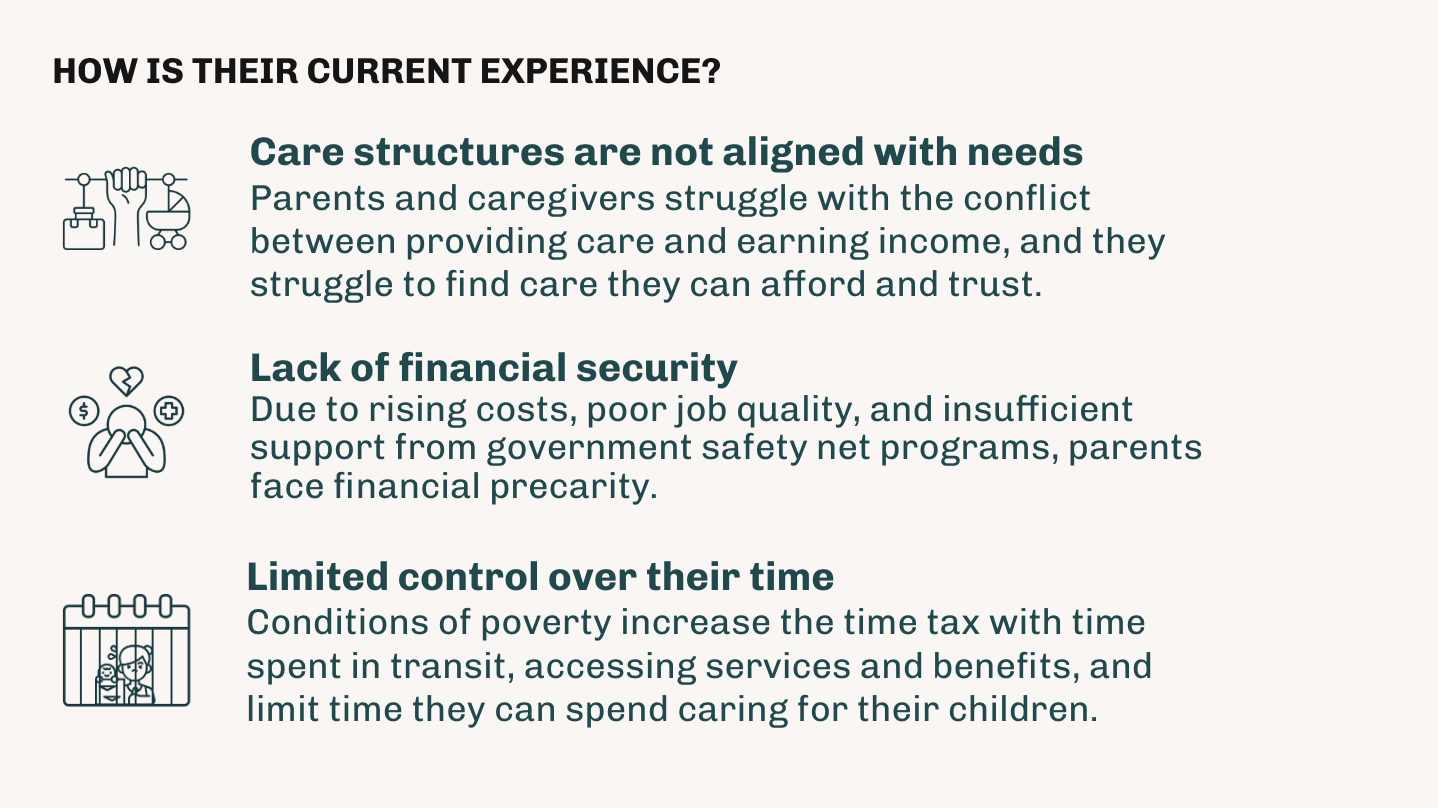
Compounding stressors make even simple tasks harder, and coordinating complex systems dreadful. These compounding stressors include lack of financial security, care structures that are not aligned to needs, and a lack of control of time.
LEARNING: SOCIAL CONNECTION PROFOUNDLY IMPACTS FAMILIES’ ABILITY TO THRIVE
Social and community support networks provide families with key material, informational, and emotional support as they navigate the daily realities of raising young children. Families with weaker networks are less likely to learn about available services and more likely to be overwhelmed by the process when they do. For a deeper dive on social connection, read this brief.
“Back home in Africa, they said it takes a whole village to raise up a child, and here in America it’s different. You are just all alone, you are just all by yourself, you know, your children are home with you all day, you know, it’s, it’s kind of hard, you know.”
“We also consider the teachers and those here [at Head Start] like family. They have supported me a lot through [my children’s] education and development. We, as mothers, learn more from the programs, how to better support our children, how to take better care of them. And that is who I consider my family. All the people who support us, especially us as an immigrant family.”
Child care is one of the most prevalent spaces where families share that their options and decisions are largely influenced by factors that are financial, logistical (e.g., location, operating hours), and social (e.g., trust, curriculum, cultural values). The cost and the lack of affordable options were mentioned as deterrents to formal child care. Parents want to pursue new skills, return to school, complete training programs, or even have time for connection with other adults, but a prerequisite is trusted care with extended hours. Parents shared that trust is a first-order criteria in their child care decision-making and hugely influential when their usual source of care is unavailable.
“We have never taken our kids for a daycare though we really know they exist. Reason being that we work collaboratively as a family making sure that mother or father should always stay at home with the kids as needed.”
“Good daycare play[s] a vital role in the life of a younger kid because it allowed them to communicate with people... Having a good daycare is something that is important.”
AREA OF INQUIRY: FUTURE-ORIENTED SYSTEM (RE)DESIGN
Are there certain combinations of programs that might best serve families dealing with particular life circumstances?
Are there certain benefits integrations that are more acutely needed by economically vulnerable families than others?
LEARNING: FAMILIES, OF ALL TYPES CRAVE THE AGENCY TO MAKE THE RIGHT CHOICES FOR THEIR FAMILY. THIS REQUIRES MORE THAN JUST MATERIAL WHOLENESS.
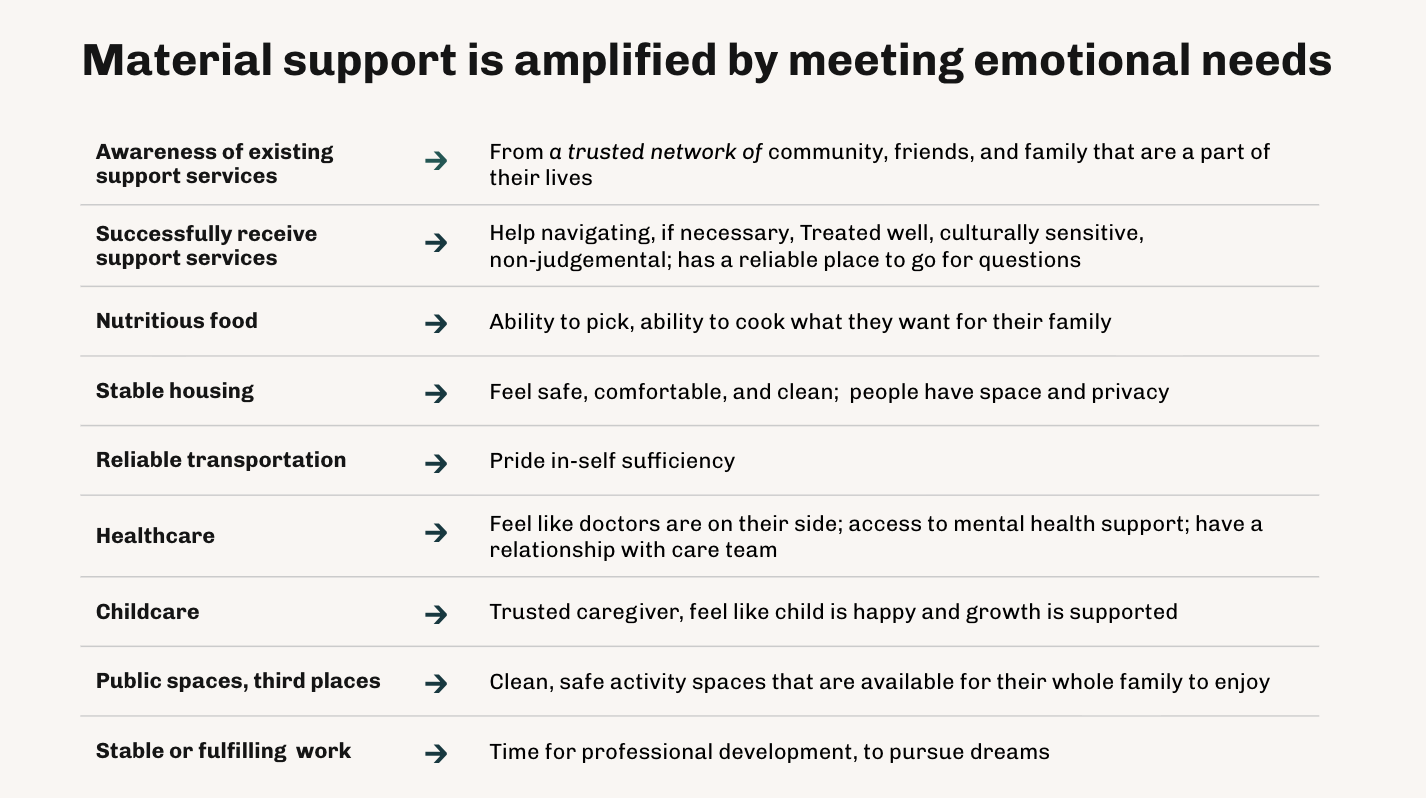
People seek autonomy in steering the direction of their lives and have big hopes and dreams for their children as well as themselves. It was also clear that policy makers should think about government services with humility. People don’t seek these interactions with enthusiasm, and may not wish to be reliant upon government support. We must recognize that even with perfect enrollment and seamless service experiences, we will not make families whole with the policies we have today. Money matters, but it is also time, connection, and agency that families seek. And, we were inspired by the ways parents continually find joy.
For more on how we’re learning about what families want, read about our national parent survey.
“I want to own a business so that I can choose my work schedule and spend more time with my family [...] [I’m] trying to go back to school to further education so that I can make a better living for my family”
“Being able to just have that few minutes to myself where I can decide if I wanna, you know, get in the Word or if I want to have a drink of coffee or catch up on a load of laundry quick or, do something simple for myself.”
Next Steps
The Minnesota and Pennsylvania diary studies concluded in Fall 2024, and our family cohort in New Mexico will run through May 2026. We are continuing to seek creative and useful ways to share these insights, and will share additional deeper-dives in topical briefs. We are also learning more about some of these themes raised on work, care, leave, and wants for the future through a quantitative study in early 2026.
